


Quantum & Classical Hybrid Fiber Communications
Summary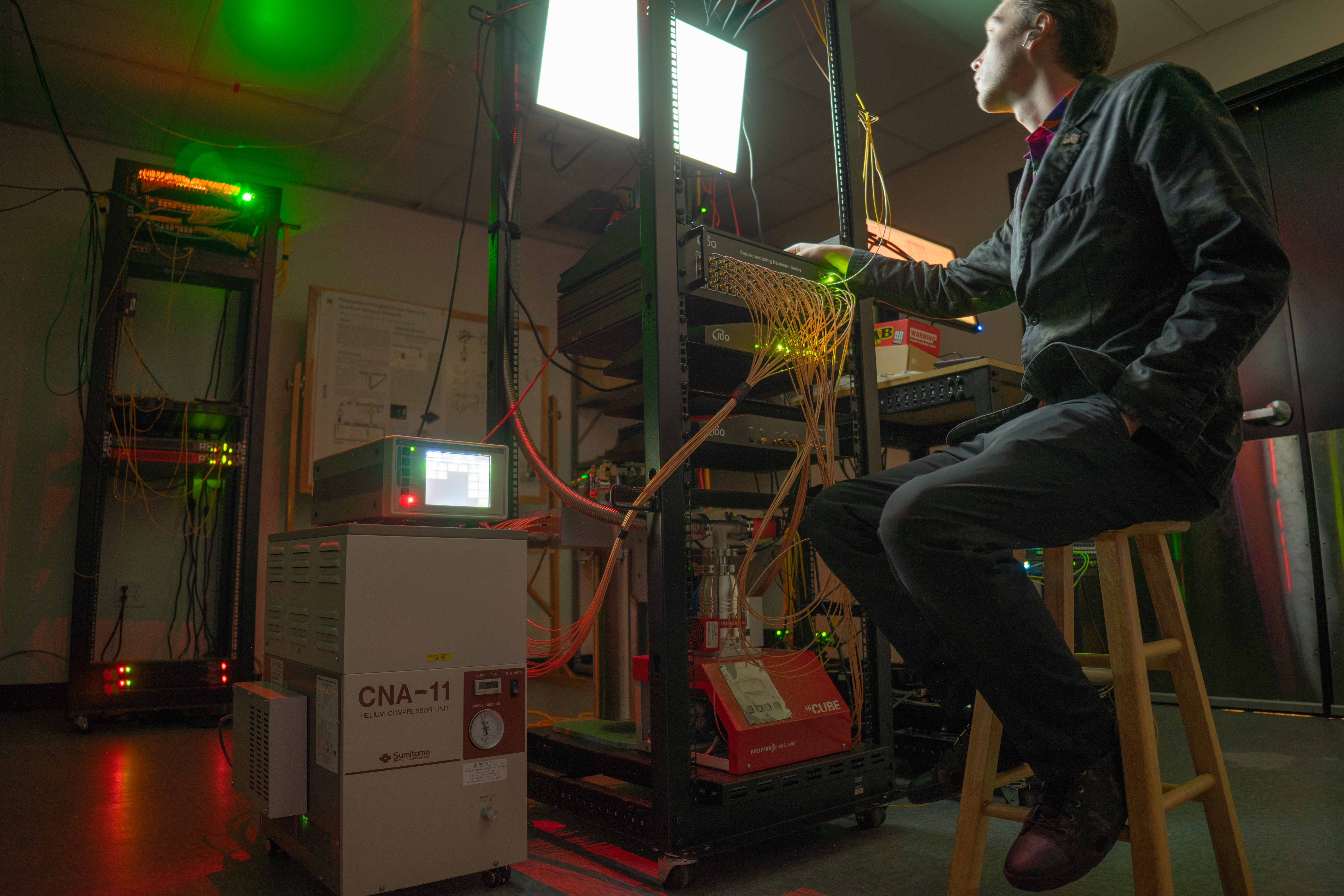
Quantum key distribution (QKD) enables secure communication by using the fundamental properties of quantum mechanics to generate and distribute encryption keys. While quantum communication provides new capabilities for secure information exchange, classical optical communication remains essential for transmitting high-bandwidth data. Hybrid quantum-classical networks combine these technologies, allowing quantum and classical signals to share existing fiber-optic infrastructure while maintaining the performance and security required for both. Research in hybrid communications focuses on overcoming challenges such as optical noise, crosstalk, and signal interference to enable practical quantum-secured networks that integrate seamlessly with today’s telecommunications infrastructure. These technologies represent an important step toward scalable quantum networks and the future of secure, high-capacity optical communications.
Spectrum lab is investigating both entangled photon generation for QKD, and how it can be used for optical communication.
Capabilities
We have demonstrated that QKD and high-speed classical telecommunications can coexist in the same multi-core fiber achieving 1.16 Tb/s of classical data transmission and 7.4 kb/s of secret key generation across a three-node network using commercially available equipment.
Personnel
Dr. Joshua Dugre (joshuadugre@montana.edu)
Samual Fritsch (samuelfritsch@montana.edu)
Ector Ayala Diego (ectorayala@montana.edu)
Nathan Kuehl (nathan.kuehl2@montana.edu)