


Holographic Communications
Summary
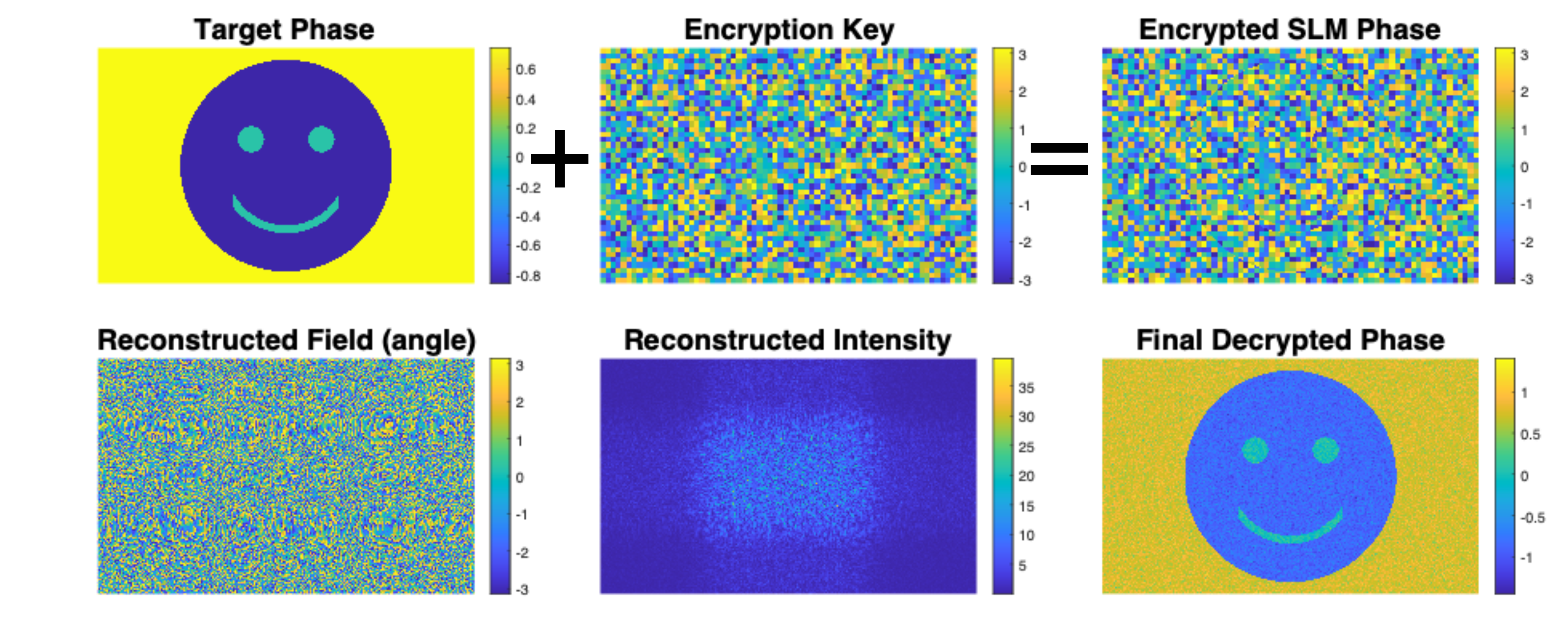
We are leveraging our expertise in digital holography to explore how holographic principles can be used to encrypt and reconstruct optical communication signals. We are exploring coherent communication geometries where the transmit and local oscillator signals co-propagate to the detector, meaning no local oscillator is required at the receiver. This geometry is advantageous because it allows for spatial encryption of the optical signal and reduces transceiver complexity, since no separate reference beam is needed at the receiving end. We are also analyzing the system's resilience to turbulence, and whether co-propagating fields make the link more resilient to atmospheric effects than a conventional design.
Capabilities
We have built and tested this approach on the bench, first as a two-dimensional demonstration using a camera and a spatial light modulator, and more recently as a simplified communication link that sends the same kind of encrypted signal one symbol at a time through a single detector. In both versions, a receiver holding the correct key recovers the original signal, while anyone without it sees only noise. This has been demonstrated using standard, commercially available photonics hardware rather than specialized equipment. We are continuing to improve data speeds and are beginning to test free-space links.
Personnel
Dr. Cole Hammond (colehammond2@montana.edu)