


Lidar & 3D Imaging
Summary
 Coherent modulated lidar/LADAR systems allow much higher detection sensitivity and
accuracy compared to the more common pulsed-beam lidar systems. The frequency-modulated
continuous-wave (FMCW) illumination beam, for instance, is constant in intensity,
but swept in optical frequency. The core operating principle of FMCW lidar is the
coherent ‘mixing’ of a portion of the modulated laser light that is split off from
the transmit beam, called the local oscillator, with the light received from the target
to produce a beat signal whose frequency is proportional to the target range. This
unique “matched filter” correlation blocks any background radiation or signal interference.
By using appropriate modulated waveforms and signal processing, the Doppler signature
(i.e. velocity) of the target can be measured simultaneously with the range. For FMCW
lidar, the signal-to-noise ratio is proportional to the total number of received photons
and not to the peak power. Thus, FMCW lidar has several orders of magnitude greater
sensitivity than pulsed time-of-flight lidar, with much lower peak powers.
Coherent modulated lidar/LADAR systems allow much higher detection sensitivity and
accuracy compared to the more common pulsed-beam lidar systems. The frequency-modulated
continuous-wave (FMCW) illumination beam, for instance, is constant in intensity,
but swept in optical frequency. The core operating principle of FMCW lidar is the
coherent ‘mixing’ of a portion of the modulated laser light that is split off from
the transmit beam, called the local oscillator, with the light received from the target
to produce a beat signal whose frequency is proportional to the target range. This
unique “matched filter” correlation blocks any background radiation or signal interference.
By using appropriate modulated waveforms and signal processing, the Doppler signature
(i.e. velocity) of the target can be measured simultaneously with the range. For FMCW
lidar, the signal-to-noise ratio is proportional to the total number of received photons
and not to the peak power. Thus, FMCW lidar has several orders of magnitude greater
sensitivity than pulsed time-of-flight lidar, with much lower peak powers.
Holography is an interferometric-diffractive imaging technique that enables the recording and reconstruction of three-dimensional (3D) images of objects. The two-step process involves recording the interference pattern formed by a reference beam and an object beam (reflected from or transmitted by the object), followed by image reconstruction. The interference pattern of the reference coherent wavefront with the wavefront scattered from the object's surface forms an intensity pattern on the surface of a high-resolution recording film. This recorded interference pattern (called a hologram) contains information about both the amplitude and phase of the object's wave field. The stored information can be reconstructed by illuminating the hologram with a reference wave, resulting in an image with three-dimensional features exhibiting all the effects of perspective and depth of focus that the object would exhibit. This remarkable technology has found many applications in diverse fields such as displays, vibrometry, and microscopy. Producing holograms requires strict phase coherence of the object and reference beam. Laser noise, turbulence, or object movement or vibration can significantly degrade the hologram.
Capabilities
Lidar
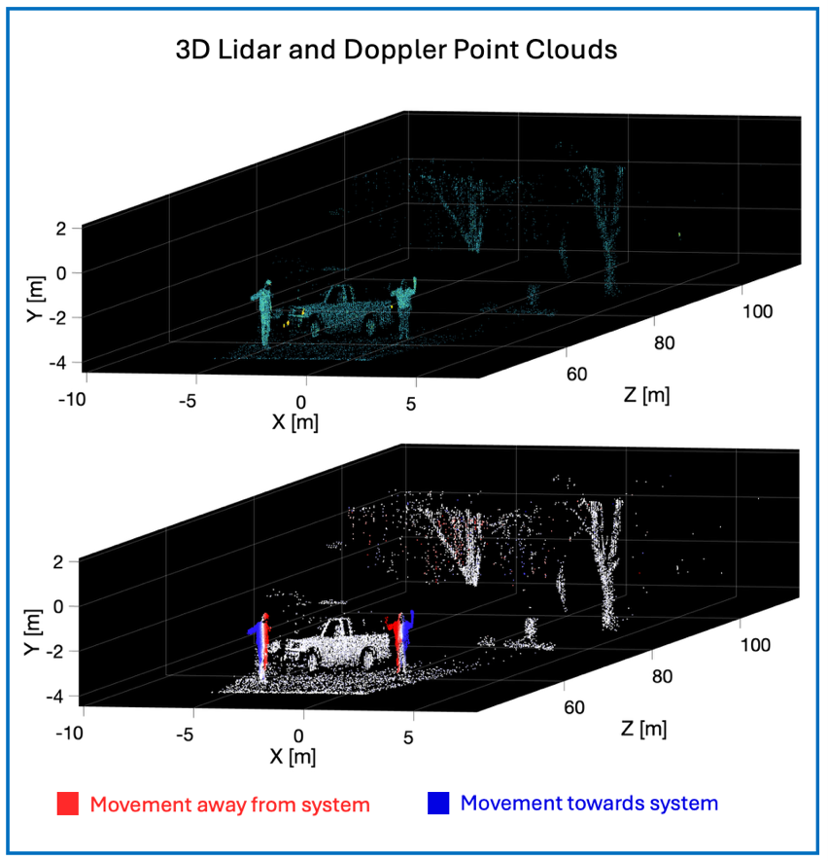 Spectrum lab has been a hotspot for FMCW lidar development for over 20 years, contributing
to the success of several spinout companies who have further advanced the technology,
such as Aurora (formerly Blackmore Sensing) and Bridger Photonics.
Spectrum lab has been a hotspot for FMCW lidar development for over 20 years, contributing
to the success of several spinout companies who have further advanced the technology,
such as Aurora (formerly Blackmore Sensing) and Bridger Photonics.
The advantages of FMCW lidar are:
- High Selectivity
- High Sensitivity
- High Dynamic Range
- High Bandwidth and Spatial resolution
FMCW lidar is most commonly used to create 3D point cloud images that capture the position and velocity of objects across large fields of view.
Holography
The development of fast, high-resolution optoelectronic devices, such as CCD and SWIR cameras, has enabled digital cameras to replace holographic film. In Digital Holography (DH), the hologram is recorded digitally, and image reconstruction is done numerically. As in classical holography, light scattered from an object illuminates the image sensor along with a reference wave, and the resulting interference pattern is digitally recorded. Access to the phase and amplitude of the object’s return light allows for additional capabilities not possible with standard holography, such as post-recording image focusing and phase front correction (e.g. turbulence mitigation).
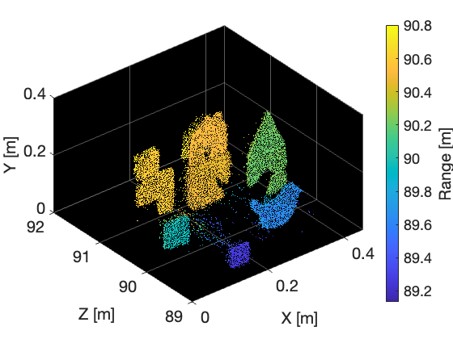 Combining digital holography with FMCW lidar principles has led to the novel field
of range-selective digital holographic imaging (RSDH), in which holograms are recorded
only at tunable distances. Spectrum Lab has demonstrated this technique by reconstructing
high-resolution 3D holograms of objects up to 100 meters away, with range resolution
on the cm scale.
Combining digital holography with FMCW lidar principles has led to the novel field
of range-selective digital holographic imaging (RSDH), in which holograms are recorded
only at tunable distances. Spectrum Lab has demonstrated this technique by reconstructing
high-resolution 3D holograms of objects up to 100 meters away, with range resolution
on the cm scale.
Because holograms are a phase-sensitive measurement, they are highly sensitive to movement or vibration. Spectrum Lab has also investigated techniques to stabilize holograms, enabling the reconstruction of moving or vibrating targets, including those displacing multiple wavelengths during integration, which would normally wash out the hologram completely.
Personnel
Dr. Cole Hammond (Colehammond2@montana.edu)
Dr. Matt Goodman (matthewgoodman2@montana.edu)
Dr. Corey Pearson (coreypearson@montana.edu)
Zachery Lakin (zacherylakin@montana.edu)
Undergraduate Researchers
James Broderick
Mischa Gregory
Garret Kuntz
Owen Naberhaus
Publications
-
Cole Hammond, Zachery Lakin, R. Krishna Mohan, and Wm Randall Babbitt, "FMCW lidar-enabled stabilization for range-selective digital holographic imaging of vibrating objects," Appl. Opt. 65, D79-D87 (2026)
-
Corey A. Pearson, Cole Hammond, Zachery Lakin, Wm. Randall Babbitt, and R. Krishna Mohan, "Outdoor demonstration of range-selective digital holography for three-dimensional imaging," Appl. Opt. 65, D38-D45 (2026)
-
Corey A. Pearson, Krishna Rupavatharam, William Randall Babbitt "Characterization and demonstration of a bench-top range-extending tower for lidar and digital holographic imaging up to 48 meters," Optical Engineering 65(3), 034111 (2026) https://doi.org/10.1117/1.OE.65.3.034111
-
Cole Hammond, R. Krishna Mohan, and Wm. Randall Babbitt, "Frequency detuning analysis in multi-chirp range-selective digital holography with temporal heterodyning," Appl. Opt. 64, 8077-8087 (2025)
-
Corey A. Pearson, R. Krishna Mohan, and Wm. Randall Babbitt, "Range-selective digital holography for three-dimensional imaging of a complex object," Appl. Opt. 64, 9169-9177 (2025)
-
Matthew A. Goodman, R. Krishna Mohan, and Wm. Randall Babbitt, "Range selective digital holographic imaging of vibrating objects using FMCW lidar," Appl. Opt. 63, 5642-5652 (2024)
- Cole Hammond, Wm. Randall Babbitt, and R. Krishna Mohan, "Range selective phase-shifting frequency-modulated digital holography with temporal-heterodyning," Appl. Opt. 62, D157-D162 (2023)
-
Matthew A. Goodman, R. Krishna Mohan, and Wm. Randall Babbitt, "Range selective digital holographic imaging using FMCW lidar," Appl. Opt. 61, B255-B261 (2022)
-
Matthew A. Goodman, R. Krishna Mohan, Zeb W. Barber, and Wm. Randall Babbitt, "Digital holographic polarimeter using dual reference beam interferometry," Appl. Opt. 60, 6526-6537 (2021)