


Micro-Optics Fabrication
Summary
 Micro-optical systems can be found in medical equipment, laser technologies, the telecommunications
industry, photonic integrated circuits, and much more. The production of these optics
typically involves custom molding or lithography techniques, which have proven to
be reliable. The downside is the long lead times and large prices associated with
these methods. With the improvement of additive manufacturing technologies, two photon
polymerization (2PP) 3D printers are being used to fabricate these same micro-optics.
Micro-optical systems can be found in medical equipment, laser technologies, the telecommunications
industry, photonic integrated circuits, and much more. The production of these optics
typically involves custom molding or lithography techniques, which have proven to
be reliable. The downside is the long lead times and large prices associated with
these methods. With the improvement of additive manufacturing technologies, two photon
polymerization (2PP) 3D printers are being used to fabricate these same micro-optics.
Spectrum Lab’s Micro Optics Fabrication Group specializes in the design, simulation,
and production of micro-optics using 2PP. This 3D printing technique is enabled by
the UpNano NanoOne 1000 3D printer here at Spectrum Lab and is capable of single line resolutions
less than 200 nm, with advantageous polymer properties that closely resemble glass.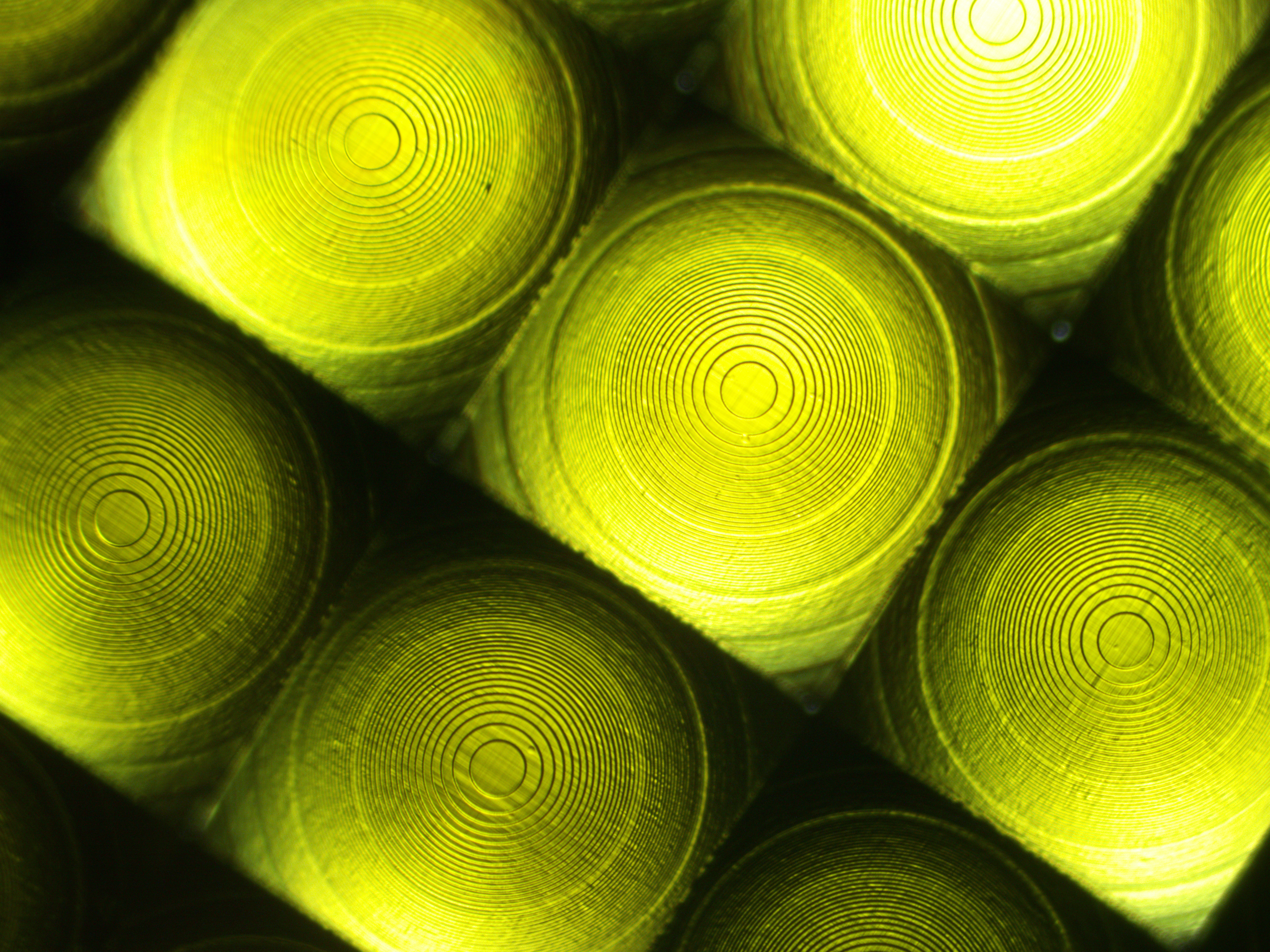
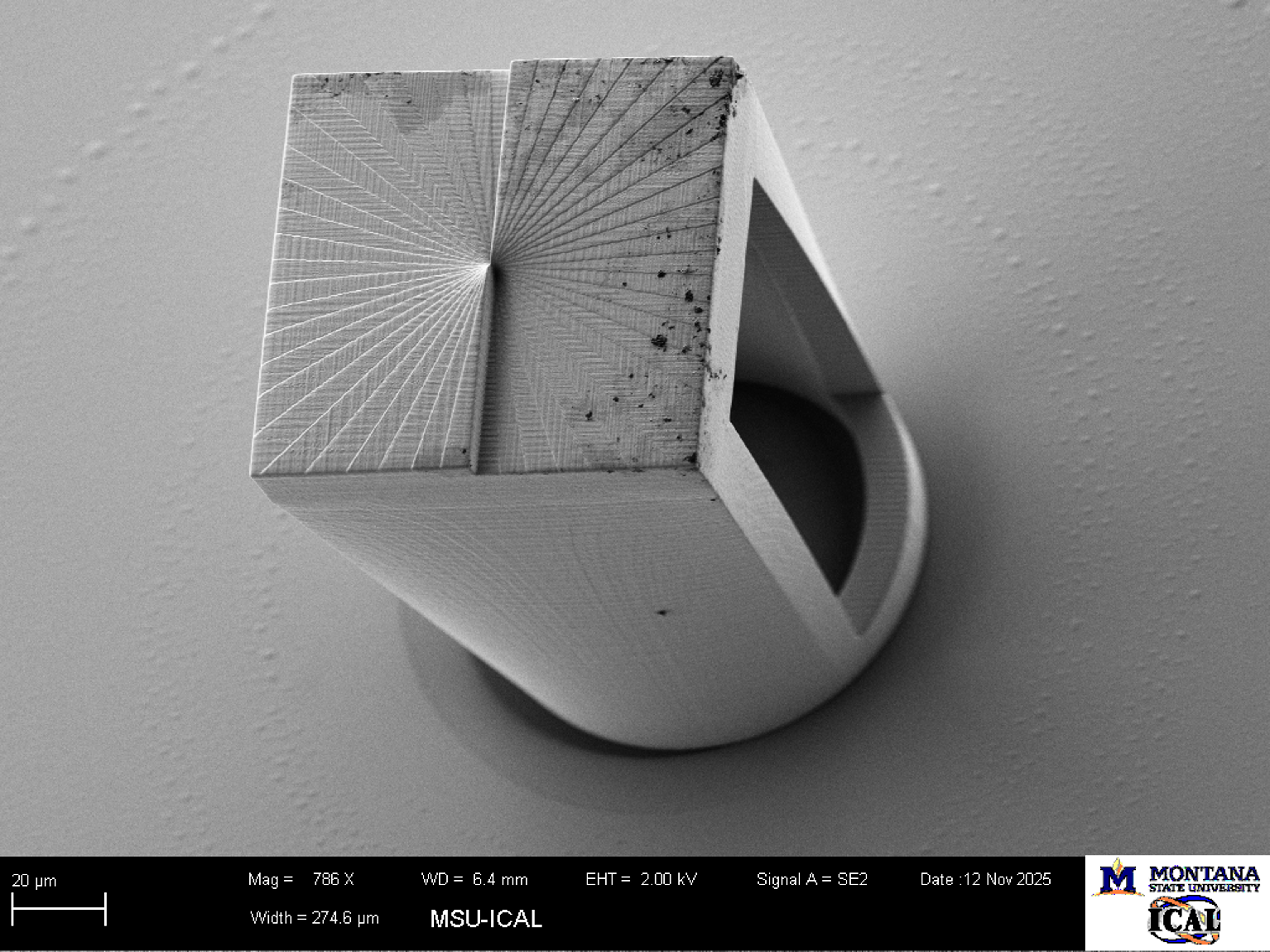
Currently, the micro-optical development aims to improve interconnects for optical communication applicationsand quantum technologies. Other research areas currently in progress include the fabrication of waveguides and the inclusion of various materials in the standard resins to adjust their optical properties. Each area of research aims to reduce the size, weight, power, and cost of bulk optical equipment or to replace traditional fabrication techniques.
Capabilities
With the UpNano 3D printer, arbitrary optics can be printed on various substrates including glass slides,bare fiber, connectorized fiber, wafers, and more. A brief list of the printer’s specifications can be found below.
- Refractive Index @ 1550 nm: 1.49-1.51
- Resolution (Max): <200 nm
- Print Speed (Max): 750 mm/s
- Print Volume (Max): 40x40x40 mm
Along with the printer capabilities, a unique workflow has been developed at Spectrum
Lab to assist in rapid prototyping and fabrication of micro-optics. In this workflow,
height maps of optics generated in either MATLAB or Python can be directly imported
into a simulation software or directly turned into an .stl file for 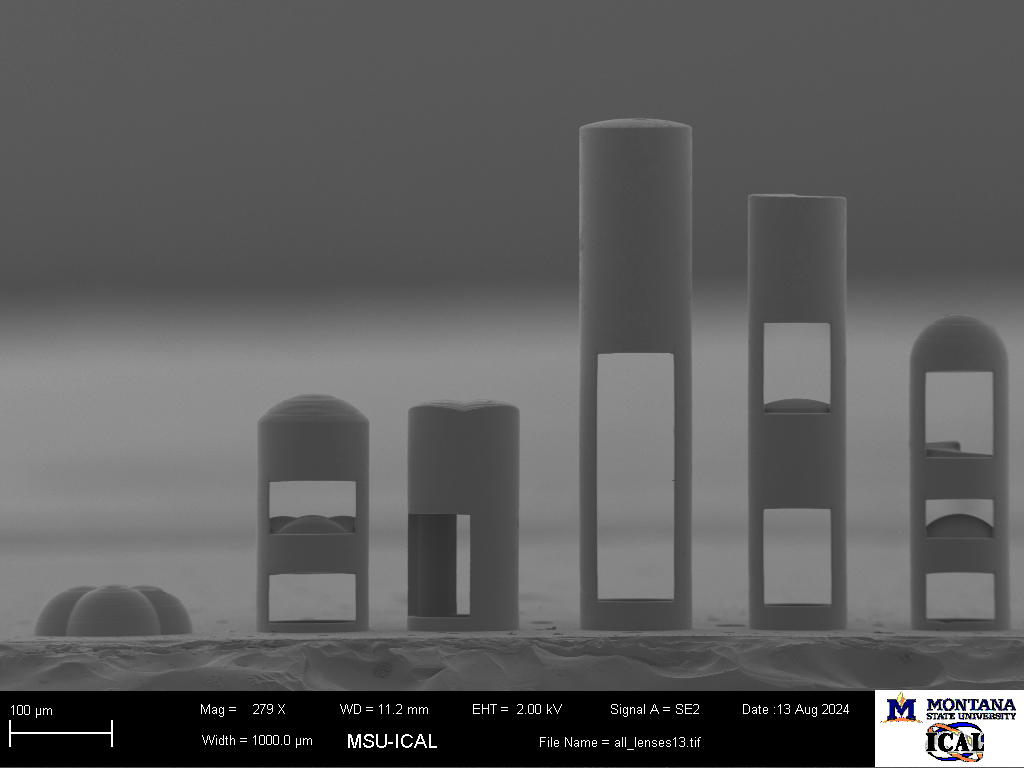 3D printing. Inversely, .stl files created in any CAD software are able to be turned
into the proper format for simulation. This allows one to verify the optical performance
before printing, and drastically improve the time from prototype to final print.
3D printing. Inversely, .stl files created in any CAD software are able to be turned
into the proper format for simulation. This allows one to verify the optical performance
before printing, and drastically improve the time from prototype to final print.
Personnel
Samuel Fritsch (samuelfritsch@montana.edu)
Dr. Corey Pearson (coreypearson@montana.edu)
Graduate Researcher
Katerina Shabalin (Katerina.shabalin@montana.edu)
Publications
-
Nano-Printed Spiral Phase Plate on Fiber Ferrules for Modal Filtering in Free-Space Optical Communications, Samuel Fritsch, Joshua Dugre, Krishna Rupavatharam, https://doi.org/10.1109/JLT.2026.3685948