


Terrestrial Free-Space Optical Communications
Summary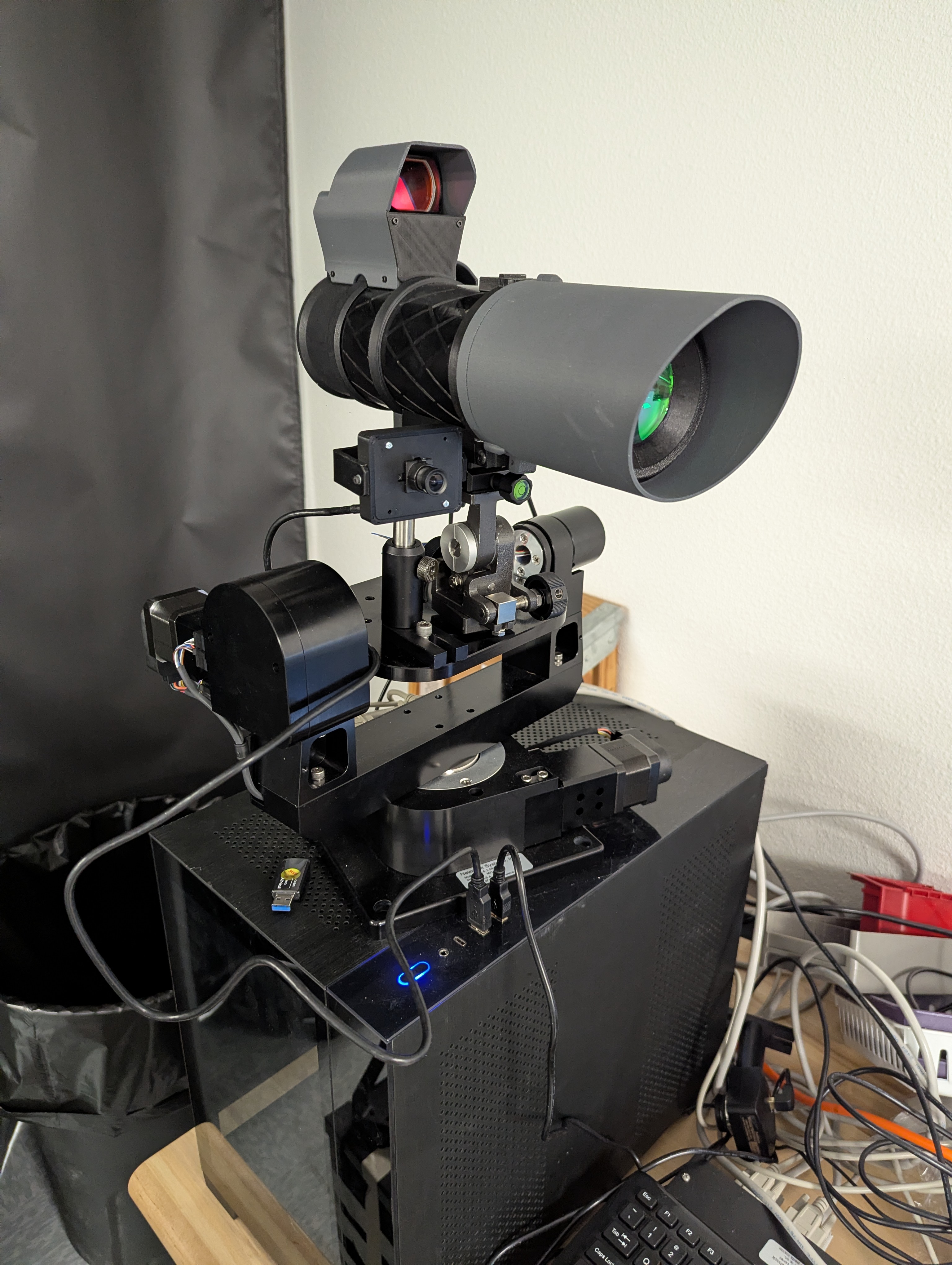
Our group develops and tests free-space optical platforms for both classical communication and quantum applications, including quantum key distribution and entanglement transport. The work covers the complete link, from the source and modulation scheme through beam propagation, receiver design, and the control electronics that keep the link aligned and locked.
For terrestrial links, atmospheric effects are the primary bottleneck on any of these systems. Turbulence distorts the wavefront and causes the received signal to fade, while dust, fog, and precipitation scatter and attenuate the beam. Part of our research is aimed at measuring, understanding, and countering these effects on optical communication links.
The group has also developed methods for generating, multiplexing, and identifying structured light. These modes add a spatial dimension to the channel that can be used for multiplexing, and they respond to turbulence differently than a standard Gaussian beam. Our work addresses how to generate and multiplex these modes efficiently and how reliably they can be sorted andidentified afterpropagating through a turbulent path.Recent workdemonstrateda dynamically adjustable astigmatic transformation thatidentifiesorbital angular momentum modes under atmospheric turbulence.
Capabilities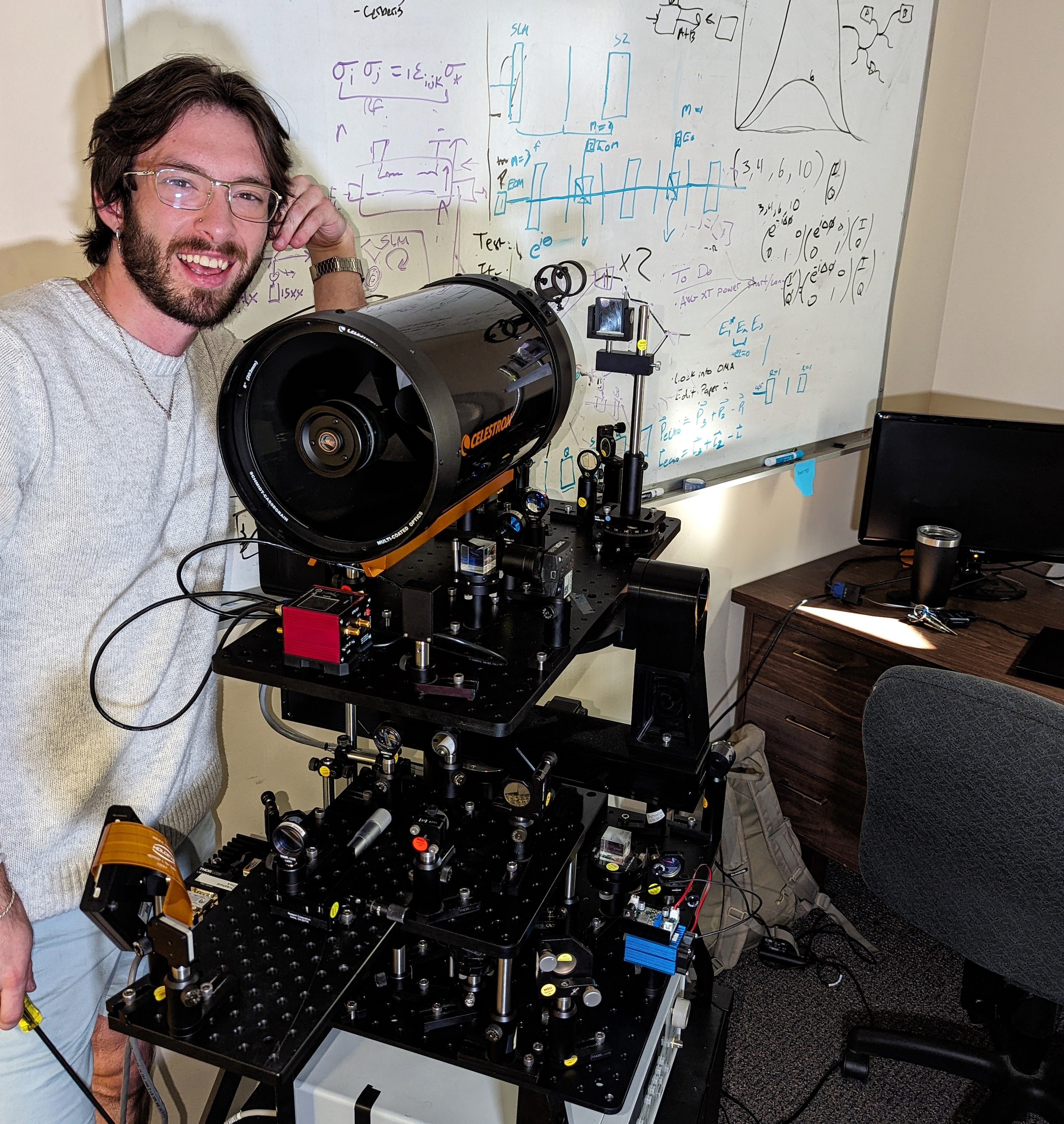
Spectrum Lab supports free-space optical research from custom optic fabrication through full outdoor link testing.
Long-range outdoor test sites are available for ground-to-ground links, which allows us to collect propagation data over distances relevant to fielded systems.
An UpNano two-photon polymerization printer allows us to fabricate custom micro-optics in house. We use it to print phase screens that reproduce turbulence in a controlled and repeatable way in the lab, and to print corrective and mode converting elements directly onto optical components. This capability was used to demonstrate a spiral phase plate printed on a fiber ferrule for modal filtering in free-space optical links.
We have in-house FPGA development expertise for real-time control of system elements, including adaptive optical components, modulators, detectors, and the timing electronics used for photon counting measurements. Custom control hardware allows for precise pointing correction and system integration.
Personnel
Dr. Dennis Dempsey (dennis.dempsey@montana.edu)
Trent Jackson: (trent.jackson2@montana.edu)
Samuel Fritsch (samuelfritsch@montana.edu)
Caleb Rohn (caleb.rohn@montana.edu)
Zachery Lakin (zacherylakin@montana.edu)
Undergraduate Researchers
Thomas Ferrel
Hutch Vujovich
Publications
- S. Fritsch, J. Dugre and R. K. Mohan, “Nano-Printed Spiral Phase Plate on Fiber Ferrules for Modal Filtering in Free-Space Optical Communications,” Journal of Lightwave Technology, vol. 44, no. 12, pp. 5090-5097, 15 June 2026, doi: 10.1109/JLT.2026.3685948.
- O. Licht, C. Rohn, and R. K. Mohan, "Dynamically adjustable astigmatic transformations for OAM mode identification under atmospheric turbulence," Opt. Express 33, 13040-13058 (2025).